
Service Areas
Commercial roofing in North Plains, OR off US 26: make-safe visits, roof inspections, drainage repairs and written scope sheets for small commercial owners.
Commercial Roofing in North Plains, OR
A call from North Plains, OR gets the same first hour as any other: confirm the room and the owner, send a crew with tarps and sealant, and photograph the roof before a hand touches it. The leak location, the date and the images go into the building file. On the way out, the crew leaves a short note saying what the temporary measure covers and when we will be back.
North Plains had 3,441 residents in 2020 on the northwest edge of the Portland metro area, and US 26 is its highway access. Its 1,266 housing units were mostly owner-occupied, and Pumpkin Ridge Golf Club sits just outside town. In a town of 3,441, each commercial roof matters to its owner, and each walk gets a full written record.
One Roof, One Owner
Where an owner has a single building, the roof is the whole portfolio. A leak affects the owner's income and the owner's own space. The decision between repair and renewal is personal and immediate. So the scope sheet states each choice in plain terms: what is wrong, what the repair costs, how long it should hold and what replacement would cost when the time comes.
We keep the first walk thorough. It covers the field of the roof, every seam we can reach, all penetrations, the edge metal, the walls and the drainage. A short report follows with numbered photographs and a ranked list of findings, each marked as a patch or a fix, with a price. A commercial roof repair estimate then ties to those numbers, so the owner can see which item costs what and decide which to do first.
Getting to the Roof from US 26
US 26 is the highway access to North Plains, and the same highway links Beaverton to Hillsboro, Portland and the coast. Crew travel and material delivery both start from it, and we plan the final stretch into town with the owner. Large loads such as rolled membrane, insulation and tear-off debris need a truck route, a place to stand and a path to the roof. A small site may need those loads split into several smaller trips.
We ask each owner for the loading point, any overhead lines near the building, the roof access method and any times when parking has to stay clear. If the roof has no interior hatch, a lift or ladder placement goes in the plan. Those practical items are what separate a smooth reroofing day from a delayed one, and they affect the price. Every occupied building reroofing schedule records them before the first delivery.
Overhead utility lines are worth a separate look. Metal ladders, lift booms and long sheets of edge metal all conduct, and a roof close to a service drop needs a stated clearance. We mark those spots on the access plan and keep materials out of them. If a line cannot be avoided, the owner contacts the utility before work begins, and the schedule waits for that answer.
Wind is the last access factor. Gusts make loose sheets and rolled membrane hard to control, so crews stop lifting when the wind passes a safe limit and resume when it drops. Spring and fall fronts can shorten a working day, and the schedule carries a float for that reason instead of promising a fixed finish.
Rain Through the Wet Months
North Plains, on the northwest edge of the metro area, sits in the same regional weather as Beaverton, which sees rain on about 151 days a year, so its roofs spend long stretches wet. Drains, seams and flashings are tested daily, and a roof that is almost watertight in October may leak by January.
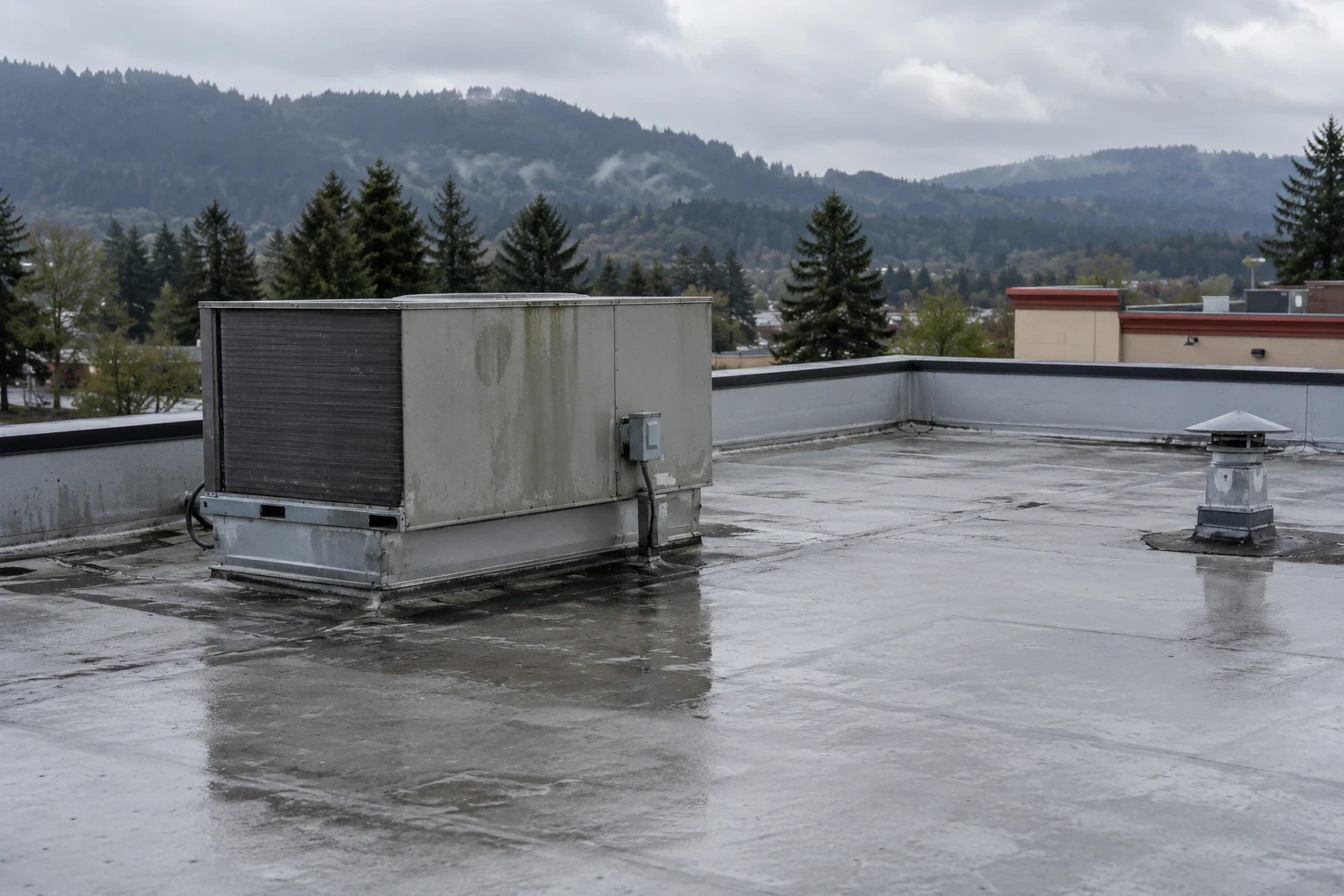
Our drainage check follows water from the surface to the outlet, which is where a small building's roof usually shows its first fault. We clear the strainer, check the sump and the membrane around it, then look for low spots where water stays after rain. Debris collects at outlets, and trees near a roof add needles and leaves. A preventive roof maintenance visit before November removes the debris, tightens loose fasteners, reseals worn penetrations and records the roof condition for the file.
Clubhouse and Hospitality-Type Buildings
Pumpkin Ridge Golf Club lies just outside North Plains, a reminder that restaurant and event buildings serve the town's edge as well as its center. If the building in question is a clubhouse, restaurant or event space, roof leaks affect guests and operations, and kitchens add exhaust and grease issues. The scope for a restaurant roof includes grease containment at exhaust fans, curb condition and the membrane's resistance to cooking residue.
A restaurant roofing repair checks the exhaust fan base, the grease trap, the curbs and the membrane around them. Grease softens many membranes, so we look for blistering or swelling downwind of exhaust. When the building has heavy roof traffic from service technicians, walk pads protect the membrane along the path. Dining rooms and event spaces also have ceilings that cannot be left open, so the make-safe visit covers furniture and finishes first and the roof investigation follows in the next dry window.
Price Drivers and Code
A small project has the same drivers as a large one in smaller quantities: wet insulation, deck condition, penetrations and access. Because a single roof carries the whole budget, unknowns weigh more. The scope carries an allowance for concealed damage, with a unit price for any extra work, so changes can be decided on facts. When test cuts show dry insulation, the allowance returns to the owner as a credit; when they show wet board, the unit price applies to the measured area only. Oregon's structural code edition for 2025 took mandatory effect April 1, 2026, with energy rules keyed to ASHRAE 90.1-2022.
A replacement scope lists those code items apart from the membrane and flashing. If the owner also holds property in Hillsboro or Forest Grove, we use the same scope layout for each building, with a summary that ranks the roofs for the capital plan.
Related Roofing Work
Commercial Roof Repair
Occupied Building Reroofing
Preventive Roof Maintenance
Restaurant Roofing
Place an intake call for your North Plains roof
Call with the building address and the last known leak location. We will schedule a make-safe visit and send a written scope sheet that prices repair and replacement separately.
Questions About North Plains
What should a single-building owner decide first after a leak?
Decide how much of the roof's life remains. A repair buys time on a sound roof, while a worn roof with wet insulation needs a larger plan. The scope sheet prices both so you can set the repair cost against replacement.
How do you get material to a small site off US 26?
We agree on truck placement and the hoist or lift position with you before delivery. If the lot is tight, the load is split into smaller trips. Debris leaves by chute or lift to the same agreed point, away from customer entrances.
Does grease from a kitchen shorten membrane life?
It can. Grease softens some membranes and leaves blisters downwind of exhaust fans. We inspect fan bases, containment and the membrane nearby, and recommend a grease-resistant detail or system where the roof shows damage.
Can a temporary seal last until the dry season?
Sometimes, but it should be treated as a stopgap. Wind, rain and foot traffic wear it down, so the make-safe note carries a check date. If the seal fails early, we return and replace it.
What goes into my building file at the end?
The dated photographs, the scope sheet, the invoice and material information. They show what the roof was and what was done to it, which helps at a sale, a refinance or an insurance review.